Sunday, 19 April 2015

An Interview with author Sean Kavanagh

Sean Kavanagh, author of Fiction on Foreign Planets, Volume 1 and Volume 2, previously released and reviewed here as A Country Fit For Zeros , has released his third collection of short stories, They Came For Our Eyes and he has also been generous enough to take the time to answer a few questions for me, in what is the first (of many I hope) interviews on this blog.

 Firstly Sean, thanks so much for taking time out to speak to me, (and for being a guinea pig of sorts), for the benefit of anyone reading this who hasn't yet read your work, if you could sell yourself to them in a single sentence, what would it be?
 I love to write the sort of books I’d like to read: fun, offbeat genre fiction – that I think that might appeal to other people.
Your short story collections are fantastic, is there any chance of seeing some longer stuff?
 That’s my main focus now.  I love short stories, both reading and writing, but the majority of readers want something longer – so that’s where I’m putting my efforts now.  I have an offbeat spy novel called “The Handover” due out later in the year, and some novellas due in the next few months.  I’m probably going to be phasing out the short stories from now. 

Can you tell us a little more about what you're currently working on?
 There’s the spy thriller, “The Handover”,  which is set in 1970s Britain and is a race-against-the-clock style yarn, set against the background of the oil crisis.   It’s essentially a movie done in book form.   I also have a couple of novellas, including a science fiction one called “The Lost Episodes”.

 There's a very specific style to your writing, will your long form pieces follow a similar style, or will there be a marked shift in tone, and even genre? 

 The longer books will be a bit more conventional, to make them accessible, but the odd and quirky ideas will still be there, just presented in a way that will hopefully appeal to more people.
 Who do you consider your major literary influences?
 I guess the first books you read and enjoy have the biggest influence on you.  For me that would be Douglas Adams, Stephen King and probably JG Ballard.
 What do you do when your not writing? How do you spend your down-time?
 Either watching all the great TV drama that’s on at the moment (we're in a bit of golden age with Mad Men, Hannibal, Breaking Bad etc), or, playing and collecting retro video games.  I used to write columns on retro gaming for a few websites – they’re probably still floating out around there somewhere.
 Do you get time to do any reading for recreation? If so,who are you reading now?
 Mainly I read on the commute to and from work – which given how slow the trains are can be a decent amount of time. I have to do a lot of reading as research for my day job in TV and advertising, so fiction is squeezed in between that.  I’m literally just starting “Bitter Seeds” by Ian Treggillis.
  Who's your favourite author we've never read?
 It’s more a series than an author: Simon R Green’s “Death Stalker” space opera series – which I can only describe as fun fun fun!
 If you were in a locked room with only one book, which book would you want it to be?
 Probably a book on escapology as I’m severely claustrophobic.  If not, then I’d have to go for a Philip K Dick short story collection.
 Thank you so much Sean, and finally, do you have any advice for aspiring authors?
 None I’m afraid – I’m still figuring it all out myself.

Thank you Sean, I think that's how we all learn, by doing, and as far as i'm concerned, you're doing very well this far.  I want to take this opportunity to wish you all the best in the future, and i will be eagerly awaiting both The Handover and The Lost Episodes.

You can find Sean's works available to buy on his amazon page.

Wednesday, 8 April 2015

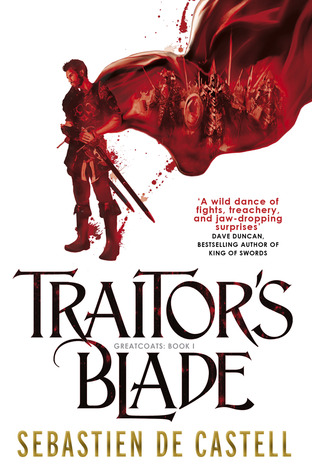
Traitor's Blade (Greatcoats Book 1), by Sebatien De Castell


 "The King is dead, the Greatcoats have been disbanded, and Falcio Val Mond and his fellow magistrates Kest and Brasti have been reduced to working as bodyguards for a nobleman who refuses to pay them. Things could be worse, of course. Their employer could be lying dead on the floor while they are forced to watch the killer plant evidence framing them for the murder. Oh wait, that’s exactly what’s happening…

Now a royal conspiracy is about to unfold in the most corrupt city in the world. A carefully orchestrated series of murders that began with the overthrow of an idealistic young king will end with the death of an orphaned girl and the ruin of everything that Falcio, Kest, and Brasti have fought for. But if the trio want to foil the conspiracy, save the girl, and reunite the Greatcoats, they’ll have to do it with nothing but the tattered coats on their backs and the swords in their hands, because these days every noble is a tyrant, every knight is a thug, and the only thing you can really trust is a traitor’s blade."


Described as a swashbuckling epic reminiscent of Alexander Dumas, this certainly evokes memories of the famous French author.  The Greatcoats are de Castell's musketeers, and they fill that role with aplomb. Falcio is a slightly older, more experienced, and jaded d'Artagnan with Brasti and Kest taking on the roles of loyal companions, much like Porthos, Athos and Aramis.

But it is from this inspiration that the book takes on its own life, and leaves seventeenth century France behind.  de Castell has created a rich world with great depth of history and social order, and it is within this landscape that Falcio and his Greatcoats are struggling to survive. Battles with evil dukes, vicious and cruel aristocratic ladies and politics to rival anything GRRM has conceived, this truly is an epic tale just beginning.

There are genuinely funny moments too among the intrigue, the relationships between Falcio and his two companions strikingly real, and honest, with the author not holding back from revealing both sides to an argument without forcing one view upon the reader.  Kest and Brasti are foils for Falcio, with each of the three having a unique perspective, and not backward about expressing their opinions. This gives the reader an opportunity to see the politics unfold from more than one perspective, while the story is told from Falcio's point-of-view, Kest and Brasti have enough meaningful dialogue to be fully rounded characters, who exist to provide this complex world with more than black and white, good versus evil, but with various shades of grey.

With book two just released, this complicated world and its fascinating political landscape looks like getting bigger and better!

Published by JoFletcherBooks in the UK.


Sunday, 15 March 2015

They Came For Our Eyes by Sean Kavanagh


Excellent as always by Sean Kavanagh. A darker twist than his previous two collections, but retaining the same short, sharp clarity of prose I've come to expect from his writings.


The Twelve, by Sean Smith

A piece of short fiction I have written for a competition.  Any and all feedback welcomed.


He made me a liar. He made us all liars. For years the twelve of us, hooked on every word, rapt with awe at the tales we were fed, believed him the hero the world believed him to be. We were his chosen, his acolytes, his disciples. And we were chosen to continue his legacy in our own corners of the world.
Twelve of us, one for each province. A saviour of our own lands, taught by the best the world had ever known. But all the world had ever known was lies.
In the before, when the world was only one, the world only needed one hero. But then the chasms formed, and the world was twelve, and so twelve worlds needed twelve heroes to follow. So we twelve followed the One.
For twelve years we studied under his constant guidance, his tutelage, his discipline. We all bore the scars of his displeasure, both physical and other, deeper, harder to hide.
The worlds were changing faster than we were learning, and all the One's lessons were based on History, and a false history at that. Everything we had been taught, everything we knew, everything everyone knew, was a lie. The key was proving it. We could save the world, the twelve worlds, if we could prove it.

The Fire Sermon by Francesca Haig

Four hundred years in the future, the Earth has turned primitive following a nuclear fire that has laid waste to civilization and nature. Though the radiation fallout has ended, for some unknowable reason every person is born with a twin. Of each pair, one is an Alpha—physically perfect in every way; and the other an Omega—burdened with deformity, small or large. With the Council ruling an apartheid-like society, Omegas are branded and ostracized while the Alphas have gathered the world’s sparse resources for themselves. Though proclaiming their superiority, for all their effort Alphas cannot escape one harsh fact: Whenever one twin dies, so does the other...

A wonderfully rich book, with huge ideas. Two very engaging lead characters, who by the end you really begin to feel for and care about.  This book says some very interesting things about disability, and the story being told through the eyes of Cass, an Omega, one of the marginalised, keeps this issue at the forefront of the readers' mind. Cass has no obvious defect, unlike her comrade, Kip, who is missing an arm, but rather is a seer, blighted by visions of the nuclear blast, among other things. The story follows Kip and Cass as they escape Cass's twin Zach, one of the leaders of the Alpha council, and the mysterious Confessor.
Making their way to a rumoured safe-hold, an island where Omegas are free and have established a resistance, the novel charts their relationship, while revealing the plans of the Alphas.  Marginalised, controlled, oppressed, the Omegas are victimised from the moment their defect becomes apparent, and this book doesn't shy away from highlighting this discrimination.

Very definitely a Young Adult book, but a book that can, and should be read at any age.  I remember reading Z for Zachariah at secondary school, and this book reminded me of that, with the themes of nuclear war, individual freedom, scientific taboo and the danger of the wrong people having too much power.  I wouldn't be surprised to see it on the syllabus in the coming years.


Thanks to netgalley, and the publisher HarperCollinUK for the free copy in exchange for this honest review.


Saturday, 24 January 2015

The Younger Gods by Michael R. Underwood


I enjoyed this book, but I loved the ending. I won't give anything away here, but suffice to say that Underwood turns the entire book on its head in such a way that makes absolutely perfect sense.
The main character, Jake, however, is massively annoying. I understand where the author is coming from in giving him such a distinctive voice, but at times its a step too far. The rest of the characters give a little more diversity to the proceedings, but I'm hoping in the following books, that Jake is toned down slightly, and the secondary characters fleshed out to more than just friends with slightly different abilities.
There's certainly enough about this book to make me interested in the next one in the series, but a few issues to be addressed.

Thanks to Pocket Star (Gallery Books), via NetGalley for the free copy to review.

Thursday, 8 January 2015

The Great Zoo of China by Matthew Reilly


Jurassic Park meets How to Train your Dragon. I can't think of a better way to describe this book.
A fantastic read, which drew me in from the very beginning, and refused to let go throughout this breathtakingly dizzying action-packed fun fest!
Set up with a minimum of exposition, and a little background to China's socio-economic status, when the story gets going, it REALLY gets going.
The book reads like the Hollywood blockbuster I'm sure it will become, and I continually found myself imagining how the dragons will look on-screen. And to be honest, that's made easy thanks to the wonderfully vivid descriptions Reilly gives us. Every scene, character, and action sequence is written perfectly in the context of the story, and it all blends together to create a brilliantly unique reading experience. I've rarely, if ever, read a book so focused on action, and this pulls it off.
At times the book verges on the excessive, and the quite frankly silly, but somehow this doesn't take anything away from it.
Rip-roaring stuff.

Thanks to Gallery Books, via NetGalley for the free copy to review.

Sunday, 14 December 2014

Book Blog

I started a new blog today. It will be totally dedicated to my book which will hopefully be published in early 2015.
The book is called A Lifelong Day, and the new website is alifelongday.wordpress.com
Check it out for news and info related to the book.

Tuesday, 9 December 2014

My Favourite Books of 2014


City of Stairs (Robert Jackson Bennett)
A wonderful book which defies genre classification, using elements of fantasy in its intricate world building, skirting the fringes of steampunk, and employing Lovecraftian monsters to bring the fear factor. All this balanced with political intrigue and religious questions. Masterful stuff.


Prince of Fools (Mark Lawrence)
A great follow up to Lawrence's debut trilogy, with a very different feel to it, showcasing his range. A much lighter book than any of the Broken Empire three, but one which also packs a real emotional punch when needed. Compelling characters are becoming Lawrence's hallmark, and this will not disappoint.


The Boy With The Porcelain Blade (Den Patrick)
The best debut I read all year. At times a tale of growing up and the trials and tribulations associated with that, at others a dark exploration of power and the the lengths some will go to to achieve and maintain it. A delicate balance managed beautifully.


Half A King (Joe Abercrombie)
From an author who has brought us so much wonderfully dark fantasy comes a young adult tale which retains all of which makes his previous books so successful, and introduces a whole new level to his craft which should win him multitudes of new fans.


The Truth About The Harry Quebert Affair (Joel Dicker)
A wonderfully complex crime novel, filled with suspense and interesting characters.  Translated into English from the original French, the story is set in New England USA, and reads very much like an American novel. A huge hit on both sides of the Atlantic, and easy to see why.

Sunday, 23 November 2014

Prince of Fools (Red Queen's War, book 1) by Mark Lawrence

Having read (and loved) Lawrence's debut trilogy, you could be forgiven for thinking you knew what to expect with his latest effort. I see them as very different beasts, as the protagonists are almost polar opposites, so too are the tone of the stories.
Jorg was all action, bloodthirsty to a degree, but cold and calculating with a deliberate endgame. Jalan, the titluar fool, is none of these things. At all. An accidental hero from a war we only hear about second hand, a self confessed coward, with more than an ounce of pride accompanying that, he is thrust into an epic quest by being magically tied to the viking Snorri.
Told in first person by Jalan, he doesn't hide, from us, his eagerness to escape this entirely inconvenient predicament. Jalan would much prefer to be hopping in and out of pretty ladies beds, than in and out of near death scrapes with the Undead and assassins.
Jorg and Jalan are both anti-heroes, but there their similarities end. Lawrence has a rare gift of making his readers root for unlikely characters, but he has done this successfully again here. Despite Jalans protestations to the contrary he develops a genuine affection for his big norse companion and puts himself in harms way to aid him. While not completely redeemed of his cowardly ways by the end, Jalan certainly goes through a change and is all the stronger for being aware of this.
Lawrence writes absorbing tales, with a roundedness to his characters that enhance the telling of these tales.

Willful Child by Steven Erikson

The author of the high fantasy series The Malazan Book of the Fallen, has crossed genres with this comedic spoof of Star Trek. Similarities will inevitably be drawn with John Scalzi's Redshirts, but these are very different books. While Scalzi's novel took meta to a new level, this is pure, unadulterated fun. Captain Hadrian Sawback is all the worst qualities of Kirk rolled up into one gigantic sleazeball, and he is all the more wonderful for that! Tammy, the sentient computer is brilliantly disdainful and acerbic, and the supporting cast fills all the stereotypes you would expect to find in the original series.
A very good spin which cleverly riffs on the storylines and characterisations of Star Trek, which Erikson clearly has a lot of affection for.  Added to this, several laugh out load moments and a genuinely engaging plot make this an extremely readable book.

Thanks to the publisher for the review copy. (Via NetGalley)

Tuesday, 18 November 2014

City of Stairs by Robert Jackson Bennett

Sometimes a book comes along which exceeds already lofty expectations. Robert Jackson Bennett's City of Stairs is such a book, and more. Many reviews have been so positive I was prepared for the glorious prose, the incredible world-building, (even to a degree, Sigrud!). What I didn't anticipate was that the book would make me think so much.
The book begins as a simple murder mystery, albeit one set in a post-deity ruled landscape. As the story develops though, so does the theme of religion and how it affects society. The world Bennett created is no longer merely a setting in which the story takes place, but a living, breathing character all its own.
The biggest compliment I can pay this book is that I have tried to start three books since I finished this, to no avail. My mind returns to Bulikov, a wondrous city filled with echoes of dead gods. The questions raised by Bennett are fundamentally existential. Do the gods create the people in their own image, or do the people shape the gods to be who they need them to be? Bennet doesn't presume to answer this, but poses the question in a totally unique way.

Stop whatever you are doing and read this book.
You're already welcome.

Sunday, 12 October 2014

Qualifying Qualification

**NON-Book Related Post**

The recent international fixtures have made me think.  Surely there’s a better way of organising these games that doesn’t interfere with club matches.  The current arrangements are, in my opinion, no longer suitable for the modern game.  As the wage payers, surely the clubs are entitled to not face long periods of time without players due to injuries received on international duty.  The recent injury of Daniel Sturridge of Liverpool, for example, occurred while training for England, against the wishes of the club who pays his wages.  Liverpool pay him £140,000 a week, and he’s been unavailable for 5 weeks, that’s £700,000.  Add to the fact that Liverpool could argue his absence has undoubtedly caused the team to drop points in their own league campaign. Highly inconvenient to say the least for Liverpool.
Also, many of these games are little more than extended training sessions, with England facing, in this current period, games against Estonia and San Marino.  The Republic of Ireland even put 7 past Gibraltar.  Not exactly competitive.
How about we re-arrange these qualification games to take place all at the same time, at the end of the season?  For example, the Premier League season runs to 38 games, so at one a week, from the start of September until the end of May.  Obviously with midweek games, and the busier schedule at Christmas, there could be a saving of seven or eight weeks, bringing the league campaign to a conclusion at the beginning or middle of April.  So, therefore, May, June, July and August would be totally free.  Obviously every other year we have Euros and the World Cup, so in the year immediately preceding those tournaments we could easily have the entire qualification process. 
The format would remain essentially the same, x amount of teams split into x amount of groups.  Under this programme, we would have all the games taking place in a ‘qualification tournament’, all in one of the countries, who would obviously lobby for the right to host in much the same way as countries apply to host the real tournaments.  The groups would be drawn immediately following the previous tournament, and would take place the year before the next.  So, following Euro 2016 the draw would be made for Euro 2020 and the qualification to take place in the summer of 2019.  The summer of 2017 would see the qualification for World Cup 2018, and so on and so on.  Under this plan, even smaller countries, in footballing terms, such as Kazakhstan, Georgia, the Balkan and the Baltic States, could host a mini tournament made up of seven to eight teams, whereas they could never hope to host the main event.  This would improve their stature within the game, and encourage the improvement of stadia and infrastructure, which would only benefit football fans in the long term in those countries.
Clubs would be on board, as it gives them access to their own players for the entirety of a season, with no inconvenient breaks, especially for foreign players travelling to South America, or Africa and back, often missing an extra game to allow for jet lag.  This would bring a togetherness to the playing squad, without damaging momentum, as they wouldn't all be flying off to various corners of the globe every six to eight weeks.   Also, for the national side, having a squad together for an extended period of time can only be an advantage, rather than for a week here, and a week there.  Add to this, the fact that the players would be fully focused without the worry or distractions of club duties looming large over them.  Even an injury which may only keep a player out for three to four weeks, is extremely damaging to a club playing an intensive domestic campaign, both with league and cup games, but essentially the player may only miss one international, so the coach is less bothered at that level (Roy Hodgson’s attitude to Daniel Sturridge, and Liverpool being a case-in-point).  On the flip side of that, the same injury picked up in the club’s off season is much less a cause for concern, and if the player then faces the possibility of missing the entire qualification tournament, the perhaps the international coach might be less inclined to disregard medical advice from the player’s club. 
Another idea would be to limit the number of team eligible to actually play in these tournaments.  With the greatest of respect to Gibraltar, San Marino, Andorra et al, games against these teams, for the majority of Europe are little more than an opportunity to improve their goal difference, and present no challenge whatsoever.  How about giving them their own tournament whereby they earn the right to play the big boys?  A preliminary group comprising of those three along with Liechtenstein, Luxembourg and the Faroe Islands.  Possibly others.  The winner then gets to enter qualifying for real, and gives them a real sense of ambition that the current set-up deprives them off.  Being cannon fodder for even the weaker nations cannot be much fun, but with a level playing field, a genuine prize, and a chance to earn their spot at the top table, and even an opportunity to improve against similarly ranked teams.
Just something to think about for UEFA and FIFA....

Sunday, 28 September 2014

Personal, a Jack Reacher novel, by Lee Child


I love Jack Reacher.  A real guilty pleasure. Except I hate that term. Why is it a 'guilty' pleasure? Why should such a thing exist? I have touched on this on an earlier blog post. We should never feel guilty for liking something. Enjoyment of anything is a good thing, and although they're not exactly high literature, I really enjoy Reacher novels.
 Big, bad, brutal, brilliant. Reacher books are just like the character himself. Completely and unashamedly aware of themselves, knowing what they are, and where they fit in this world.  This is book 19, and they are only getting better.
 Lee Child is an author so comfortable inside his character every nuance feels so realised, it is almost impossible not to inhabit that world with him.     'Unputdownable' is a word overused in literature reviews, and I have, thus far, refused to dish it out regardless of how much I liked a book. But each and every Reacher novel, and short story Child releases cries out for this descriptor to be thrust in its direction.    A fast-paced thriller, with plenty of action, this does exactly what it promises. It fits a mould, and is the best of that mould.  A formula which works, which Child has, over the 19 books, honed to almost perfection.  A huge fan-base does not happen accidently, and does not happen for bad books.  A great addition to a great series.  Bring on book 20.

Red Seas Under Red Skies by Scott Lynch


 The follow up to the hugely impressive Lies of Locke Lamora, (also reviewed on this blog), comes across as a very different book. The scams, while equally elaborate take a back seat in this installment to the adventure and survival of our heroes.
 A smaller cast, initially, due to the heart-breaking events at the end of the first book, we meet Locke and Jean recovering from that epic showdown. Their relationship has changed as well, giving Jean much more of an important role.  The characterisation is much more developed here, we see stresses between characters which didn't exist, or were ignored, earlier.  This makes for a rounder reading experience as we can relate to the players, rather than simply be impressed by them, as was often the case in the first book.
 With the book starting with just Locke and Jean, the scale felt small and intimate. Gradually though, Lynch introduces more characters, both friends and foes.  Each of these feels real too, which is a real testament to the author's skill. As with book one, a lot of plates are spinning at once, and here, much more so, the characters actually add to and influence the plots rather than simply exist as pawns within the game.
 A much more mature book, and a brilliant sequel to a really good debut.

Tuesday, 2 September 2014

Update on goings on


Very quick post here, to explain a lack of reviews on here lately.

I am currently trying to write my own book, and have been for a while now.

But now i can say, it is going to be published!

Titled A Lifelong Day, it will be available in paperback and on kindle, both through amazon.com and .co.uk

I expect (hope) to have it finished and released before Christmas, so I can take advantage of the season of goodwill, hint hint. A great stocking filler it will make, no?

So, that's that then.

Cheers.

Friday, 18 July 2014

A Country Fit For Zeroes by Sean Kavanagh


Very like Sean Kavanagh's previous effort, Fiction on Foreign Planets, (also reviewed on this blog) this is a collection of very witty, very sharp, very short short stories.
Kavanagh's style of writing is excellent and perfectly suited to this genre. The brevity of the pieces is also perfectly aligned with the subject matter, as there is no wasted set-ups, or superfluous dialogue.
Each story is unique, and straight to the point. This is certainly an advantage here as the book can, and probably will, be devoured in one sitting.
As with Kavanagh's previous effort, highly recommended. .

Saturday, 12 July 2014

Half A King by Joe Abercrombie

A bit of a departure for an author well known for his 'grimdark' style. But easily his most readable book yet. A genuinely engaging protagonist, with an absorbing story of betrayal, camaraderie and amidst all of this, the not so easy task of growing up.
Very deliberately a Young Adult novel, this still pulls no punches, with explosive action scenes and themes ranging from slavery to mass murder.  Abercrombie manages here to deliver a book which should retain enough of his unique style to keep long term fans happy, while (hopefully) introducing a new generation to a different type of fantasy.
 The second son, crippled from birth, Yarvi suddenly finds himself King after his father and brother's death. Betrayed for the throne he didn't want and left for dead, Yarvi, via slavery, shipwrecks and near starvation (to name but a few trials!), makes a last stand to reclaim his birthright.
 Forging unexpected friendships, dealing with and overcoming difficulties and differences, staying your course in the face of adversity. These issues and more make this fantasy novel so relevant and important to younger readers.
 Well done Joe Abercrombie. And this is only part one of a planned trilogy to be released over the next year and a half. If the next two installments are half as good as Half a King, then they'll be too good by half.
Quite simply, this is the best book I've had the pleasure of reading for a long, long time.

(Also, please note the signed copy I was lucky enough to get, so thanks Joe and HarperVoyager for that!)

Golazo by Andreas Campomar


If you like football, and the history of the game in arguably the most football loving part of the world, this book is a must read.
A little bit laborious to begin with, as the author goes into, for me, a little too much detail on the beginnings of the game in that part of the world. The pace improves as the book goes on, and is in parts educational and insightful.

Friday, 6 June 2014

Fiction on Foreign Planets

Fiction on Foreign Planets
By Sean Kavanagh


A short story collection where the word 'short' really does not do it justice. Very short, snappy slices of sci-fi, and very funny in places.    The stories all follow a similar pattern, a standard sci fi set up, alien setting, or alien characters, or both, with a quirky twist at the end of each, all of which are very satisfying in their own way.
 My personal favourite is one which tries (hilariously) to blame global warming on tge Roswell landings.            Another about a sentient android spreading disease throughout the galaxy is intelligently written.
 Overall a very quick, enjoyable read. Recommended.

Thursday, 29 May 2014

The Lies of Locke Lamora


 Ive heard this book described as a 'heist story', and while there certainly is an element of that within its pages, this is so much more than that simple description. We're introduced to the protagonist Locke as a child thief, a ward of the 'Thiefmaker', and very soon discover that Locke is a bit of a handful, to say the least. What follows is his transfer to the stewardship of Father Chains, under whom Locke and his new friends develop skills to enhance their particular brand of thievery. Very soon they begin what is a very intricate heist, one which would leave Danny Ocean and Thomas Crown scratching their heads.
 We're also introduced to a complex criminal hierarchical system, and a threat to its leadership. Locke's skill set brings him to the attention of one of the parties, and his unwilling involvement in this power struggle soon sees the heist almost abandoned as lives are risked and allegiances tested.
 Flashbacks in the form of 'Interludes' give us glimpses into the bonds formed between Locke and his gang of Gentlemen Bastards.
 The world created by Lynch is brilliantly realised, and with only the briefest of backgrounds given to explain its construction, I look forward to revelations in the subsequent books of the series.
 The dialogue is also fantastic in that the vulgarity of the streets juxtaposed with the eloquence of the nobility meshes almost seamlessly and adds to the sense that there is so much more than meets the eye to this story.
 What I really liked was that although this is the first book in a series, it was a self-contained story with a clear beginning and ending, leaving us with just our heroes, and a sense of what might be an over-arcing scheme on a much grander scale to continue the adventures.

The Dresden Files: Storm Front


I have been aware of these books for quite a while, partly through the short lived tv series (of which I remember very little, to be honest), but had been put off reading them simply because I had heard that the first few were not very good. And to me, there is no point in reading a series of, to date, 15 books, if you're not going to start at the beginning. So I put Dresden off, and off, and off.
Really wish I hadn't.
This book was great. A great 'hero' and a really great magic system which is so important in carrying a series through so many novels.
There are flaws, but these are small enough to not impact too negatively on the reading, which is quick as the plot really flies along, as well as introducing us to various characters and settings.
I really liked this book, and if it is considered one of the weakest of the lot, then I really can't wait to pick up the rest.

Wednesday, 23 April 2014

The Truth About The Harry Quebert Affair by Joël Dicker

A difficult book to review. A book within a book. A crime novel about people, about relationships, about books. A love story, a bromance. All these things and more make up The Truth About The Harry Quebert Affair.
A book with a compelling core which had me hooked from the opening pages, its relentless twists and turns kept me guessing right to the end. A truly disturbing revelation about one of the main characters (don't worry, you'll find no spoilers here!) genuinely left my jaw on the floor and that doesn't happen often.
While the central characters were deftly written and nuanced, some of the background players were little more than caricatures, Marcus' publisher and mother for example. These niggles stop the book being a classic and that is a shame as it was an entirely enjoyable and satisfying read.

*A free e-ARC was provided by the publisher via netgalley.com in exchange for an honest review.

Published by Quercus Books with a release date of 01/05/14


Wednesday, 9 April 2014

The Boy With The Porcelain Blade by Den Patrick

Sometimes reading a book by a new author is a difficult experience. It's like meeting someone for the first time, a little awkward, not quite at ease with each other. Other times, though, it's an entirely different situation where you immediately feel like you've known them forever. This was how I felt when I met, sorry, read Den Patrick's debut novel. The titular boy, Lucien, an Orfano, in the world of nobles is less than, and at the same time more than that. Amongst political intrigue and deception, Lucien struggles to find his place in the world while also trying to simply stay alive.
A beautifully written novel, with a greatly sympathetic protagonist set in a world you really feel we've only scratched the surface of.
I look forward to spending more time with new friends
 in Demense throughout the rest of this trilogy.
Very highly recommended.

Tuesday, 1 April 2014

The Girl Who Would Be King by Kelly Thompson


A superhero story with a difference. Two girls blessed with super powers,  one good one bad. Not the most original of set-ups, but done very well nonetheless. The good girl was perhaps a little bland and predictable,  but this book really came to life when focusing on the evil character.  The descent into madness was drawn out exceptionally well and made for a fuller character than the good version.  While the ending was a little obvious, its hard to criticise as things are rarely wrapped up neatly, and this proves that fact.

Redshirts by John Scalzi


As a (massive) Star Trek fan, I'd put off reading this book for a while as I was worried it would be a little condescending towards it. It was actually quite the opposite. A really good story oozing with affection for the obvious inspirational source material. Really inventive in parts with enough nods to trends and tropes inherent in scifi space operas to give it a really familiar feel. The only real criticism I have is that the characters themselves were pretty one-dimensional. This may have been because they were extras within their own show, and as such didn't have too much personality, but I found myself, towards the end of the book caring more about how clever the resolution would be rather than if the main players would all make it to the finish line. That said, a good story that was an easy read and ultimately very enjoyable.

Thursday, 25 April 2013

Not Fit For Purpose


In recent weeks the FA has become more and more shambolic.  The organisation has shown time and time again that they are not fit to be in charge of the game.  I accuse them here of being both incompetent and negligent in their duties of care towards the players.

The number one role of the FA has to be to govern the game, and to ensure, through that governance, the safety of the players who compete in their competitions. I believe, in this respect, that they are not fit for purpose.

Two recent incidents which grabbed the headlines are the tackles of Wigan’s Callum McManaman on Newcastle’s Massaido Haidara, and Sergio Aguero of Manchester City on Chelsea’s Davis Luiz.  Neither player, despite overwhelming evidence of wrongdoing, was punished by the FA.  This shows complete disregard for the injured players, and sends out a message that such tackles are acceptable.  The fact that the FA didn’t act because they said at least one official had seen the offence, is hiding behind their own rules.  Agureo got off because McManaman did, and a precendent was set. In this respect the FA, and their disciplinary process are not fit for purpose.

Following England’s World Cup qualifier in San Marino, reports were rife with accounts of the travelling support singing racist songs aimed at Rio and Anton Ferdinand.  Despite at least one radio station being forced to apologise live on air because the singing was clearly audible on the broadcast, the FA could find ‘no evidence’ that racist songs were sung by any England supporters.  Countless fans and journalists, if approached, would have been able to provide said evidence.  Yet, the FA buried its head, proving to the world that all its rhetoric on tackling racism within the game, is no more than lip-service.  In this respect, and in the matter of investigating misdemeanours by its own, the FA is clearly not fit for purpose.

On of the mandates the FA set itself was to establish and develop football at grass roots level across the length and breadth of England. Despite over £200 million being spent, football is, according to the Sports Minister, “the worst run sport in the country”.  The gulf in wealth between the clubs at the lower end of the game, and those in the upper echelons is gigantic, and getting bigger season after season.  The FA has a duty to care for, and help ensure, the financial stability of all clubs, and not just those who are the global face of brand ‘FA’.  In this aspect, the are also not fit for purpose.

All this brings me to the events of this week.  No-one with a modicum of intelligence could defend the actions of Liverpool striker Luis Suarez in the game against Chelsea.  To bite a fellow professional is reprehensible, heinous, and utterly bizarre.  But the FA’s immediate declaration that the charge of violent conduct and three match suspension that would normally accompany it, was ‘clearly insufficient’, is another example of their disciplinary process being deeply flawed.

While a bite is all those things, and more, it is much less an offence that racially abusing someone, or endangering an opponent’s safety with a reckless challenge.  Yet the FA deem it worse than both, issuing the Uruguayan with a ten match ban.  What is even more perplexing is the way they dealt with, or rather didn’t, deal with Jermaine Defoe in 2006. Defoe bit Javier Mascherano, then at West Ham, and received, on the field, a yellow card.  A precedent had been set.  Earlier in the same season, Ben Thatcher was booked for a challenge that left Pedro Mendes in hospital being treated for brain trauma.  The FA rightly decided that a yellow card was insufficient and slapped an 8 game ban on the Man City player.  They used an ‘extraordinary circumstances’ clause to retrospectively act in this instance.  By neglecting to take action against Defoe, the FA suggested that biting did not fall under  ‘extraordinary circumstances’.  Yet now biting is worth a ten game ban.  Seems pretty extraordinary to me.  The FA hides behind precedent when it suits them, and violates it when it doesn’t.  Precedent is used to ensure parity, and that each offence is treated the same.  In violating those basic principles of governance, the FA prove once again they are not fit for purpose.

None of this actually matters, because the FA is, and always been a law unto itself, changing its own rules when it sees fit, and woe betide anyone who challenges their all encompassing authority.  Until the clubs all get together and act as one, the FA will remain NOT FIT FOR PURPOSE.

Wednesday, 24 April 2013

Adaptations


Recently my TV viewing has been dominated by so-called ‘genre’ shows. Game of Thrones, Arrow, The Walking Dead, among others.

One thing about these and many other programmes, and films, is that they are not entirely original pieces of work. Arrow is based on DC comic Green Arrow, Game of Thrones on George RR Martin’s best-selling ‘Song of Ice and Fire’ series of fantasy novels.  The Walking Dead is based on the series of graphic novels of the same name.

Being as they are though, based upon existing works, they exist in pre-conceived worlds, with carefully created characters, and deviation from these tenets is usually ill-advised.  In Game of Thrones for example, the main characters, the main events, are set in stone, and only those on the periphery can be altered, and only slightly.  Martin has created an entire world, and any adaptation for the screen has to be faithful to this. The main bones of the original work must be adhered to, and the fact that the original work in this instance is unrelentingly good is in its favour.

Arrow, on the other hand is based upon one of the DC universe’s less popular characters. Green Arrow began life as a Robin Hood type figure dispensing his own version of justice in Star City.  He went through several changes, from Bruce Wayne-esque billionaire playboy to, after losing his fortune, a champion for the poor and disadvantaged. He was even killed off at one point! The character made a comeback a few years later, but with the original comics still largely unknown, the writers and producers of this adaptation, find themselves with a great deal of relative freedom to ‘tweak’ certain things.

The Walking Dead, meanwhile is burdened with the fact that the original material, like Martin’s ‘Song of Ice and Fire‘, is immensely popular, and its fans incredibly loyal. Any change made for the television show is immediately jumped on and dissected.  The show has, in terms of general story, direction, and tone, stuck largely to the template set out in the graphic novels.

There are, therefore, two groups of people who watch these shows; those who are familiar with the source material, and those who are not. There are benefits to being in either camp. Dramatic moments on screen are often such, simply because we don’t know what is coming. If, like me, you have read all of ‘Song of Ice and Fire’ (at least all GRRM has written to date, but that’s for another day!) then very little in Game of Thrones is going to come as much of a surprise. However, knowing the original material sometimes allows for a deeper understanding of what is happening on screen, knowing a little more about a character, a little more about what made him the man he is, or why he does the things he does, can often enhance a viewing experience.

Its a double edged sword and I believe there is room for both ideals, a re-telling of the same stories we have read before, and a new fresh perspective on tired old characters. In most things, if the stories or the characters were not interesting first time round, there would be no call to re-visit them, in any form.

Sunday, 22 January 2012

The Power of the Internet

This past week two issues came to my attention.  One was a global issue and grabbed the attention of newscasters, bloggers, and generally the world’s media.  The other however was just as important yet by Monday had received almost no coverage or indeed support.

Saturday 15th April 1989 ninety-six football fans lost their lives at the Lepping Lane end of Hillsborough football stadium.  One of these fans was 15 year old Kevin Williams.  He went to a football match and never came home.  His mother Anne was told he had died at 3.15pm but eye-witnesses have him asking for his mum at 3.55pm.  More than forty ambulances were held outside locked gates at the stadium for more than an hour and denied access to the scores of people who were dying just yards from them.

Basic medical assistance would have saved Kevin’s life.

The cover-up in this case reaches beyond Kevin’s death but the facts remain that had police let the ambulances into the ground some of the 96 would not have died.  The police also made witnesses lie on record cover up their mistakes.

Anne set up an online petition to ask the Attorney General to grant her request for a new inquest into her son’s death.  The petition required 100,000 signatures by 4.00pm Thursday 19th January.  By Monday 16th the e-petition had slightly more than 8,000 signatures.  A campaign began on Twitter to bring attention to it, and the need for lots of signatures in a very short space of time.  Liverpool fans and indeed football fans of all clubs took the issue in hand and tweeted links to both background articles and the petition itself.  Celebrities as diverse as Joey Barton and Piers Morgan tweeted and re-tweeted pleas for signatures and the petition had the required number of names by early Thursday morning. At the cut-off time the number had swelled to 117,420.

This is a testament to the power of the internet and what can be done when enough people get behind a cause that goes beyond tribal and partisan lines.  It is the first step in a long journey for Anne which began twenty-two years ago, and hopefully will end with Justice for a mother who lost her son.

Anne Williams, You’ll Never Walk Alone.

The second issue was one of a global nature and centred on the Internet itself.  The US government wanted to push through Congress two pieces of legislature,  the Stop Online Piracy Act (SOPA) and the Protect Intellectual Property Act (PIPA), which would forever change how the internet was to be used and controlled.   The Bills were created to prevent piracy but as they are financed by the Motion Picture Association of America (MPAA) to the tune of $94million, they smack of being firmly in the interest of corporate America, and this is not what the Internet was created for.

A campaign, more aggressive than Anne’s has been underway for quite sometime to prevent these acts being made law.  The internet is not the property of the US or any other government and should not be policed as it is.  The campaign is with this in mind.  Websites like Wikipedia and Reddit went dark for twenty-four hours, Google and Yahoo replaced adverts on their sites with links to information on the bills, and almost every site with upload facilities (such as YouTube and Facebook) are opposed to the bill.

These bills are more than an attempt to clamp down on online piracy, it is a blatant coup d’etat by America on the international governance of a free an open internet.  It will do little or nothing to prevent online piracy but will, for millions of ordinary users, destroy the internet forever.  The only winners will be the massive media corporations whose interests are, despite what they would have us believe, not as much about the ownership of ideas as the ownership of the revenue generated by these ideas.

Sites used by millions on a daily basis by almost every internet user will be changed forever.  You will no longer be able to post photos on your facebook status, or share YouTube videos on Twitter unless you have express permission from the creator.  Every post will be regulated and controlled and the internet will become a police state at the control of the federal US government.

The massive protests and responses forced the two Republicans who created the bills to pull their support effectively ending them as an immediate threat.  It is a testament to how strong the feeling was about this issue, and like Anne Williams cause was carried through on a tide of public opinion.  Perhaps more important for Anne, because had these acts been passed the twitter campaign would never have been.

The internet is the most powerful tool many of us have at our disposal and we must protect it.  My blog is still in its infancy but I believe in it and I hope it grows and grows.  It is not lost on me that I am using the internet to put across my ideas and I hope whoever is reading this feels free to share this blog with as many people as they can.  After all the sharing of ideas is what the internet was created for and it is not up to anyone to decide how that should be done.

Once again thanks for reading.

Sunday, 8 January 2012

My Wife Called Me a GeekNerd

I admit it freely; I am a geek, I am a nerd.

Star Trek, Star Wars and StarGate.  Doctor Who, Transformers, and Buffy.  You name it I've watched it and probably loved it.  There is something about the entirely improbable that compels me, from aliens to vampires, from time travel to big giant robots, and everything in between.  These elements are part of my staple TV diet and I wouldn't have it any other way.

Similarly, my love of books reflects this.  My bookcase is dominated by authors such as Raymond E. Feist, Terry Brooks, George RR Martin and of course Tolkien.  Worlds that don't exist, Midkemia, MiddleEarth and Westeros, are as real to me as this one. Imagination is a wonderful and beautiful thing, and kids (and big kids!) have been enjoying theirs for ever.

Fantasy, Sci-Fi, geekdom and nerdism, this is what I am.

I am proud of this, but I wasn't always.

It is never easy to be the butt of jokes, but it is something you can get used to.  You develop a thick skin, an outer veneer of protection.  But it is not completely impenetrable, nothing really is when you're a kid in a big world.  You start to believe the jibes, that you are somehow less important than those taunting you.  I took solace in the crew of the USS Enterprise, in the fact that the TARDIS could go anywhere it liked, anytime it liked.  I still do, but now I just enjoy the shows, then I needed them.

So when my wife called me a 'geeknerd' I blinked only at the two terms being thrust together like some kind of alien-predator hybrid.  It was a term of endearment, and only slightly motivated by the fact that she believes me to still be a child:-)

Like all things, it will take time to catch on, to become a term we can all be comfortable with.  Like Arsenal fans taking the (initially) derogatory term 'Gooner' to their hearts, being called a geek at one time would have brought a vehement denial, but not now.  Likewise nerd was not a term I would have loved, now though I embrace it.

I have accepted being a geeknerd, and will wear the term like a badge of honour.  It doesn't matter in what way your imagination flourishes, in what worlds you take comfort, or in what terms you are seen by others.  Be comfortable in yourself and those around will be comfortable in your company.

I am proud to be a geek, and i am proud to be a nerd.
I am a geeknerd.

Wednesday, 4 January 2012

media learn

Right here goes.....
I came very late to the social media party, and have learned very slowly about its uses and applications.  Let me start at the beginning for you.

Less than two years ago I bought my first computer(well second but the first disappeared on a train somewhere between Amsterdam and Rotterdam, more on that in a later blog) without really knowing why or what I was going to do with it.
Shortly after that my girlfriend (now wife *smileyface*) came to me and said she had got herself a Facebook.
I laughed, oh how I laughed.

Two weeks later I had a Facebook too.
My next purchase was an iPhone, and with it a Facebook app.  I could now keep up with all my friends on the go!! How awesome is that!!! However, it wasn't enough, I knew these people, I knew what they were up to anyway because I could talk to them in real life, I needed more.

So..Twitter.
Now I could keep tabs on famous people too. None of Facebook's need for accepting or requesting Friendships that potentially hamper my nosiness. All you have to do is click a little "follow" icon, and as long as you (to a certain extent) minded your Ps and Qs you could stalk your favourite twittarati to your heart's content.

Now I need to explain at this point that while I enjoyed looking at Facebook and Twitter I rarely posted anything on either site, I was an observer rather than a participant.  This has changed recently and I will go into the reasons for this in another post, but for now I am a Tweeter or whatever term is appropriate.

Thus this blog, 140 characters just sometimes isn't enough.  I will try to use this blog to talk about football, TV, books, or whatever comes into my mind at any point.  I hope it will improve my writing and allow me to articulate more clearly, and hey maybe my tweets will make more sense.

 Thanks for reading.